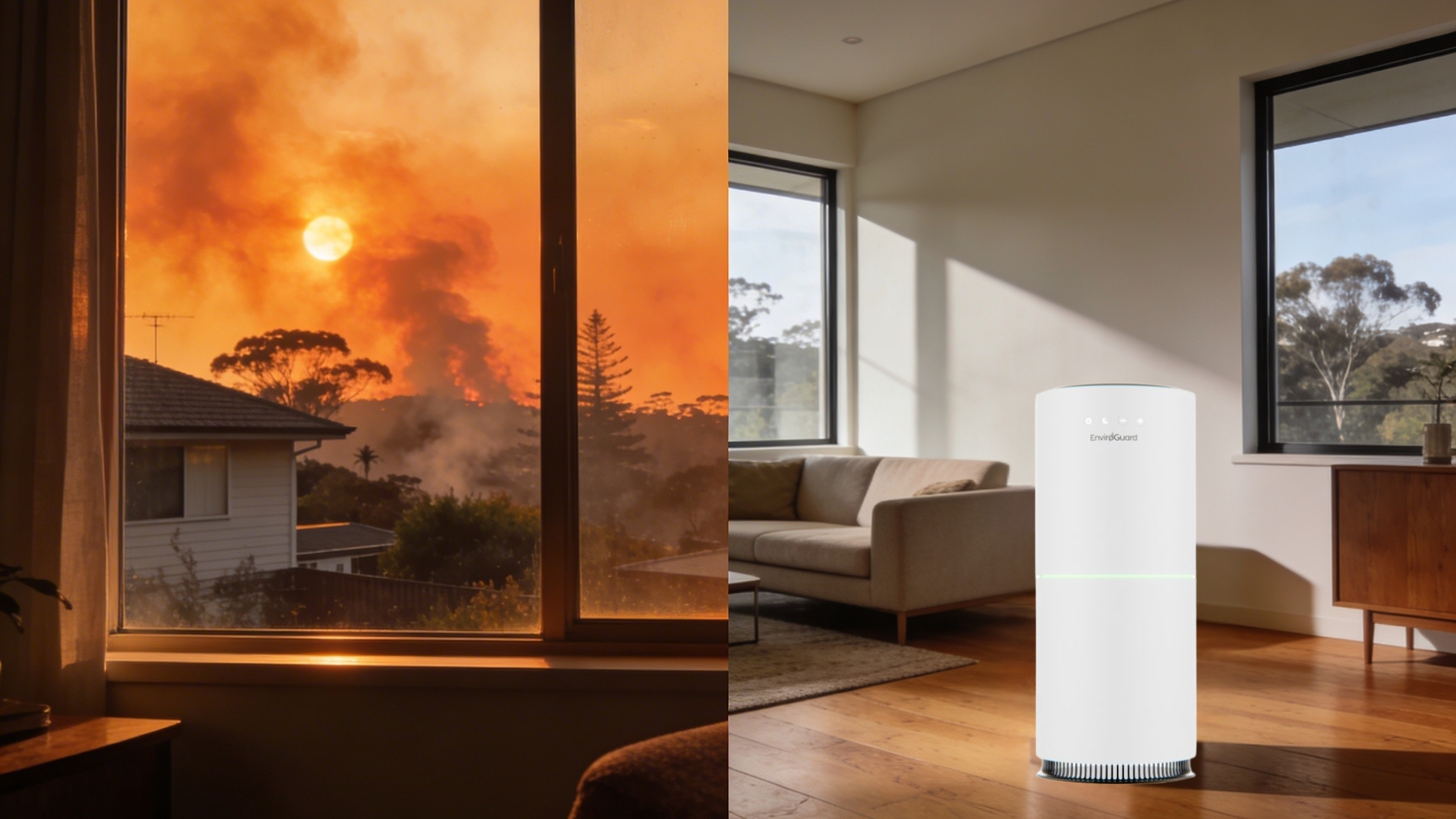
To reduce allergy symptoms through Australia’s pollen season, work on the air inside, not just the medicine cabinet. Keep pollen out by closing windows on high-count days and running your air conditioner on recirculate. Clean and treat your AC filters and indoor coil before the season starts, so the system filters allergens instead of spreading mould. Run a HEPA 13 air purifier in the bedroom, sized to the room. Then cut the year-round allergens, dust mites and mould, with hot washes, weekly damp dusting and humidity control. None of this replaces your doctor’s advice, but it makes the air you breathe for most of the day a lot easier to live with.
Every October the same thing happens. The wattle finishes, the grass takes over, and people who were fine all winter start waking up blocked and itchy. Most of them blame the garden. Fewer realise that the pollen they breathe at 2 am came in through an open window at 4 pm, settled into the carpet, and is now being pushed around the house by an air conditioner nobody has cleaned since last summer.
This guide covers when Australian allergy season actually runs, how indoor air quality affects allergies, and the practical steps for your HVAC system, air purifier, filters and surfaces that make a real difference at home and at work.
Australian Allergy Season Timing
In southern Australia, grass pollen season runs from 1st October to 31st December. That is when the allergenic Northern-hemisphere grasses flower, according to ASCIA, and when Melbourne Pollencounts grass pollen daily. Victoria’s thunderstorm asthma forecasts run over the same three months.
Tree pollen comes earlier. The ANUputs the tree pollen season at roughly mid-July to October, with weeds such as plantain shedding pollen from October into February. Further north the pattern blurs: Brisbane and Darwin have no sharp season, with grass pollen present for much of the year.
Indoor allergens don’t follow the calendar at all. House dust mites thrive in humid coastal cities year-round, and mould grows wherever there is moisture, which in October means condensate pans and bathrooms as much as walls.
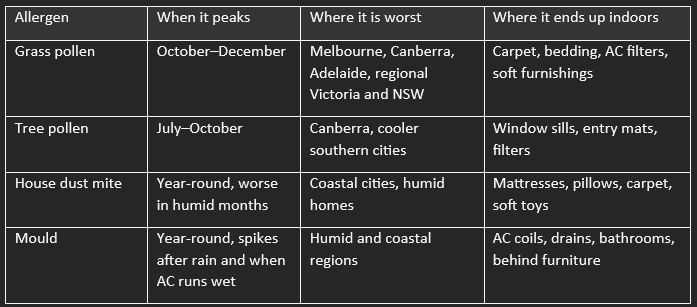
Check your local forecast rather than guessing. Melbourne Pollen and the Canberra Pollen Count publish daily readings through the season, and both report that a wet spring produces more extreme days.
How Indoor Air Quality Affects Allergies
Pollen is an outdoor problem that becomes an indoor one within hours. It rides in on clothes, hair, pets and open windows, then settles into carpet, bedding and curtains. Every footstep and every burst of air from a vent lifts it back into the air you breathe.
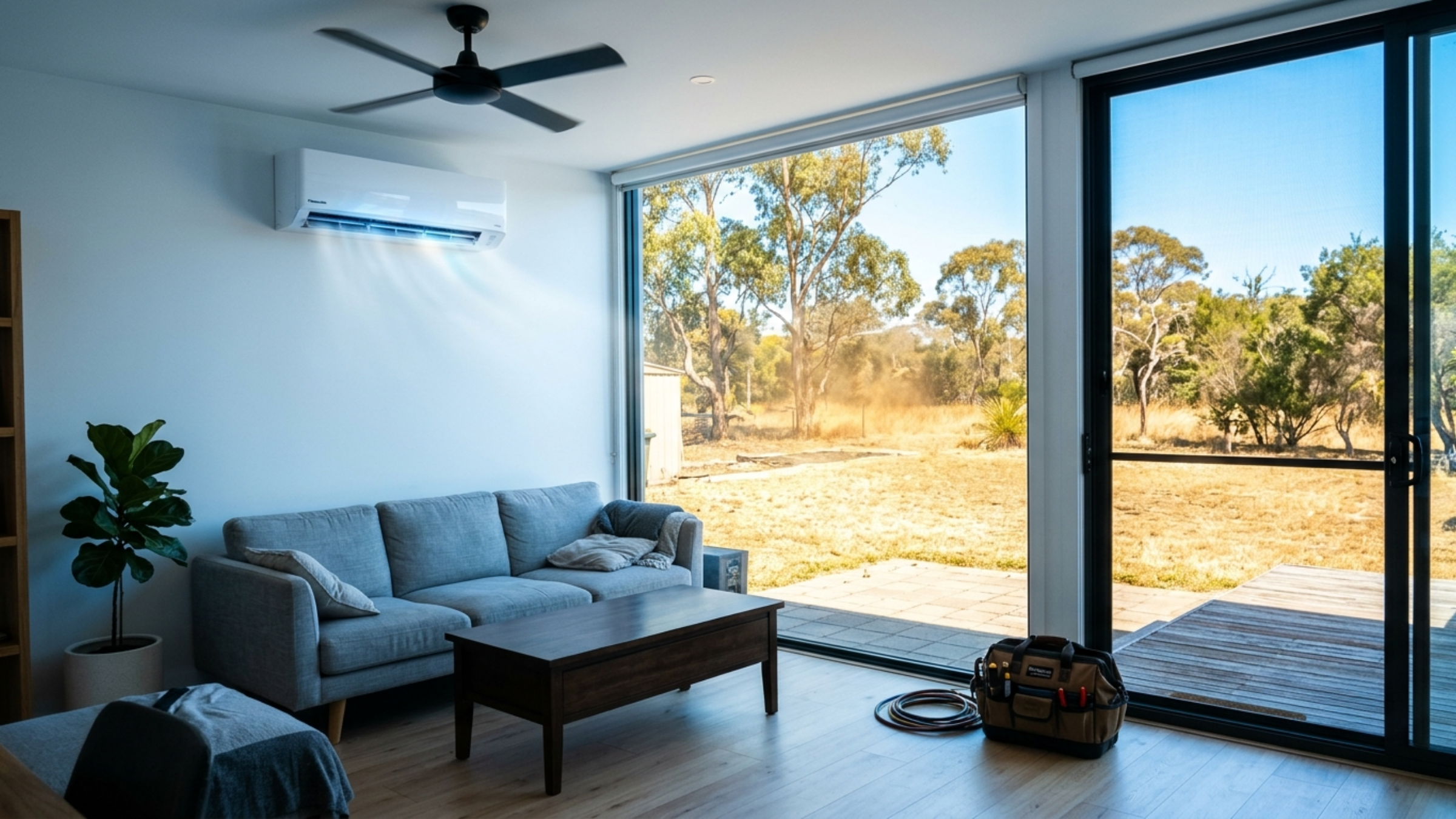
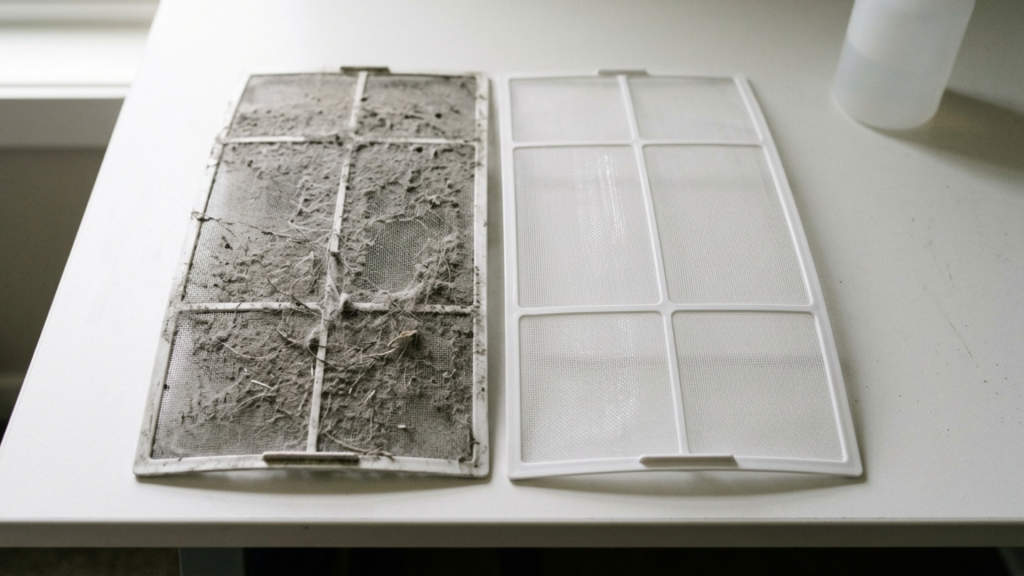
Your air conditioner decides whether that is a small problem or a large one. A clean system with a sound filter traps pollen and dust on every pass, which is why many people feel better in a well-maintained air-conditioned room. A neglected one does the opposite. Dust loads up the filter, the damp indoor coil grows mould, and the fan blows mould spores and fine dust into every room. The musty smell when you first switch on in spring is the giveaway.
That is why hay fever at home often feels worse at night. You are lying face-down in bedding full of dust mite allergen, in a room where the AC has been circulating whatever it collected over winter. Add a bathroom with mould in the grout and you have three allergens working on you at once.
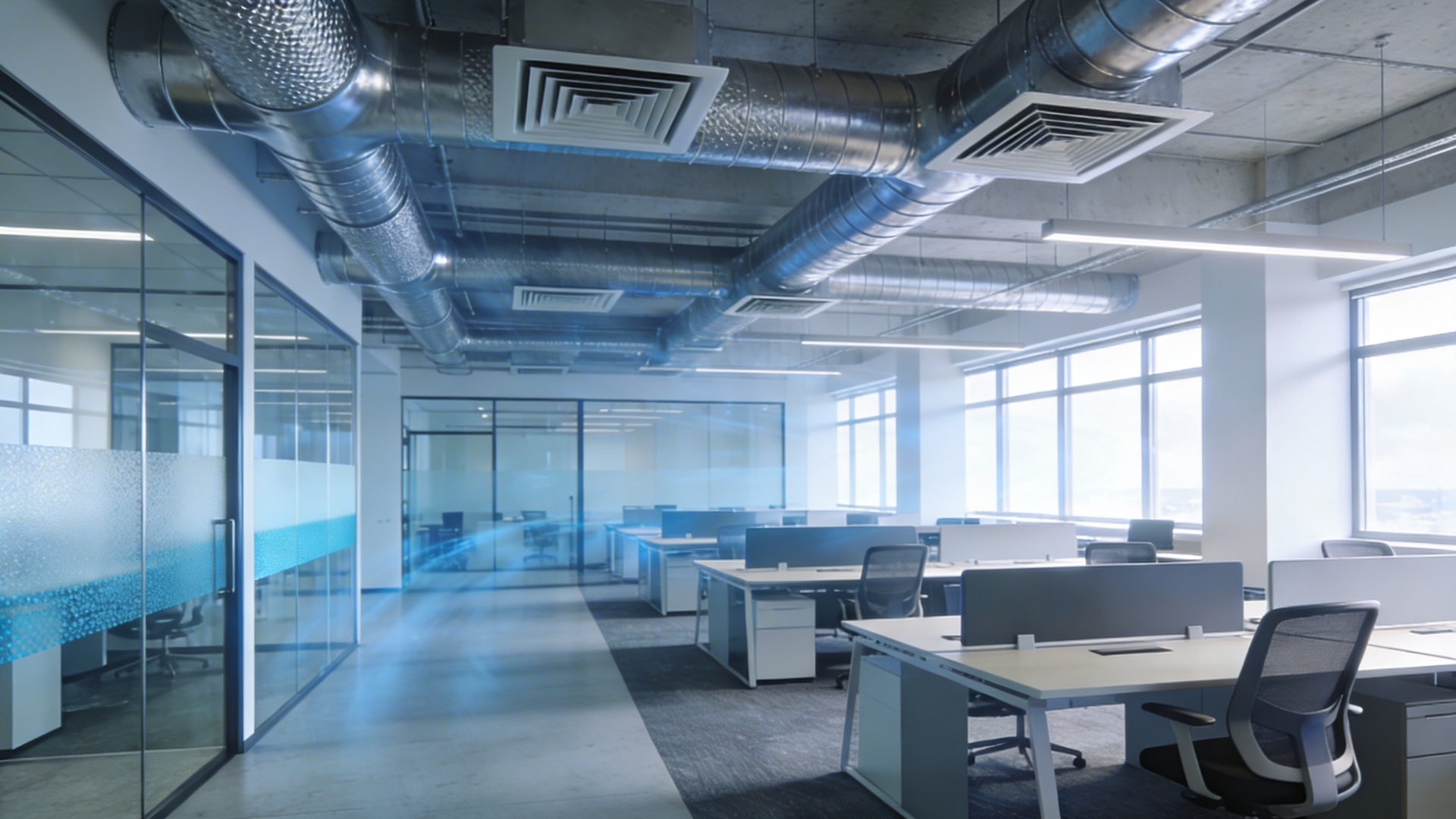
Workplaces are no different, just bigger. An office air handler pulls in outside air through intake filters that may not have been changed since the last pollen season, then distributes it to a hundred desks. If colleagues start sneezing in October, the building’s fresh-air intake and filter bank are the first place to look.
HVAC System Preparation for Allergy Season
Do this in September, before the grass starts. A system that is clean on 1 October filters pollen for three months; one that is cleaned in November has already spread two months of spores around the house.
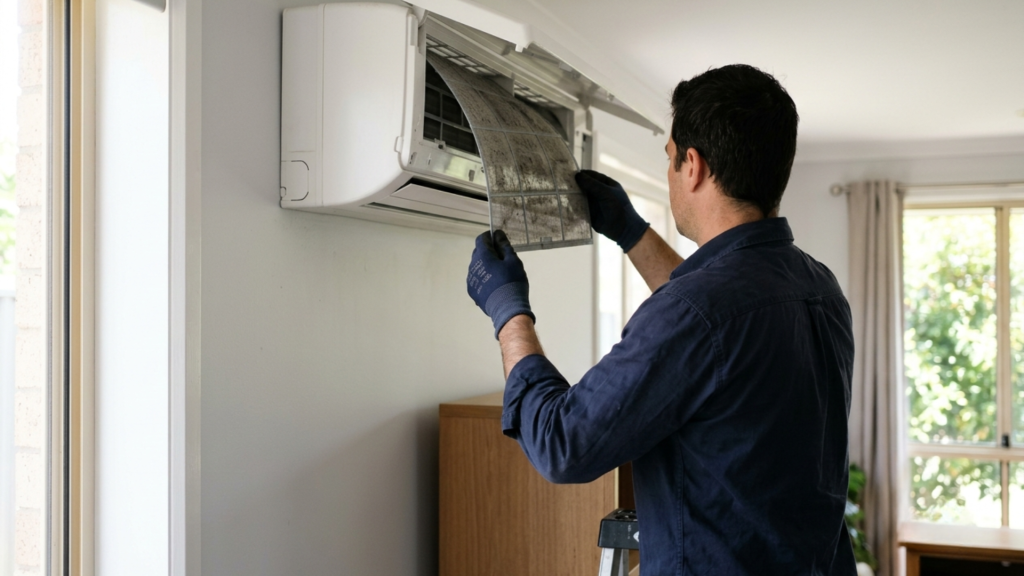
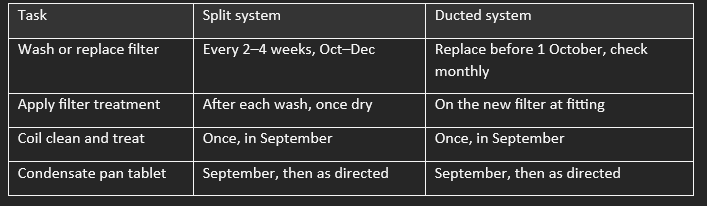
Wash or replace the filters (20 minutes).Pull the mesh filters from a split system and wash them in warm water, or swap the pleated filter in a ducted return. Let them dry fully before refitting. A damp filter grows mould within days.
Treat the filters (5 minutes). Spray clean or new filters with AerisGuard Bioactive Filter Treatment. It slows the growth of mould and bacteria in the dust the filter traps, so the filter stays cleaner and airflow holds up through the season. More on this in the filter section below.
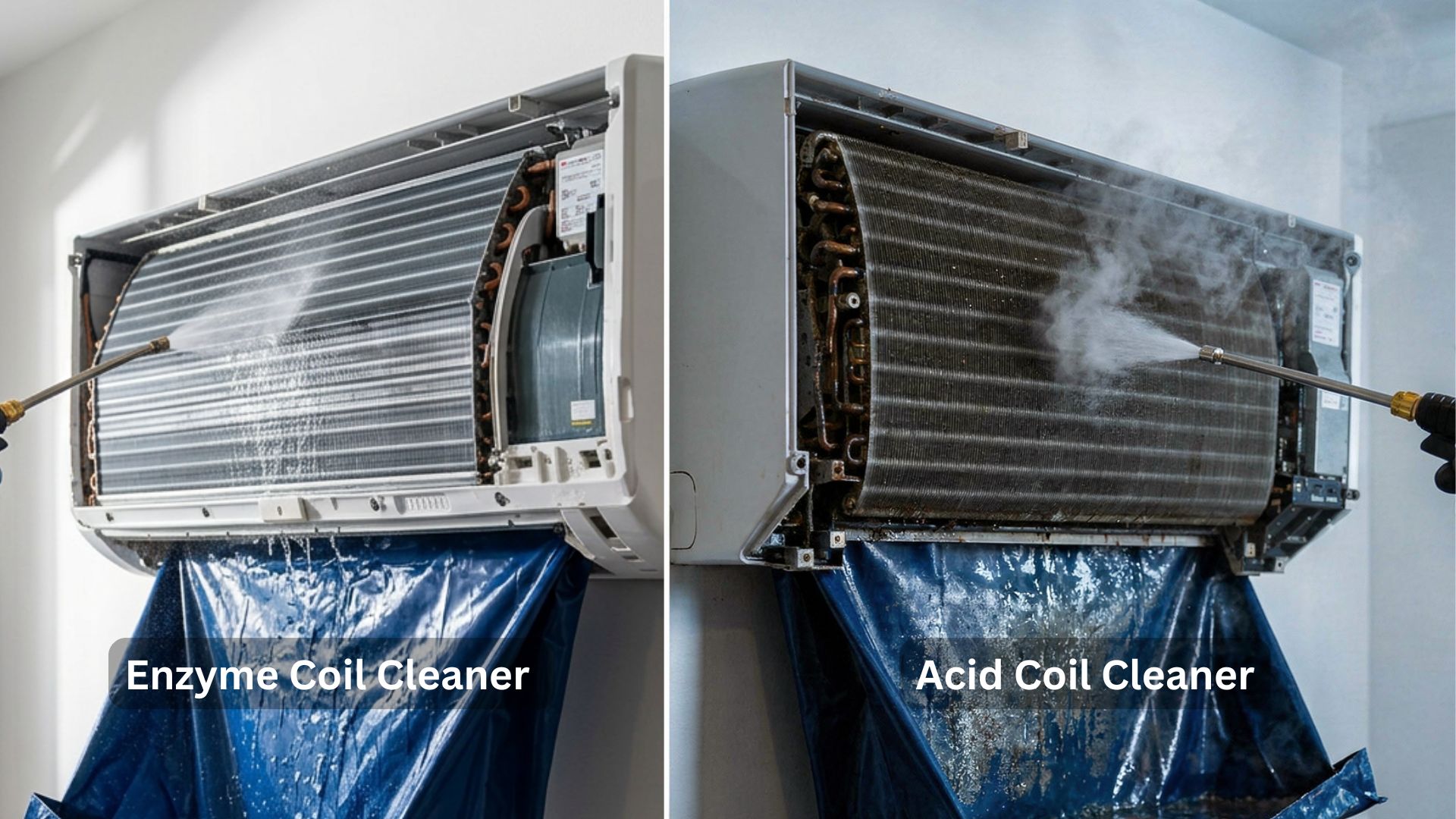
Have the indoor coil cleaned (1–2 hours, technician). The evaporator coil sits wet all summer and is where most AC mould lives. Ask your technician to clean it with a pH-neutral enzyme product such as AerisGuard HVAC Coil Cleanerrather than an acid wash, which can corrode the fins.
Protect the coil for the season (15 minutes, technician). AerisGuard Indoor Coil Treatmentis applied straight onto the clean coil and gives up to 12 months of residual protection against mould and odour-causing bacteria.
Drop a tablet in the condensate pan (2 minutes). An AerisGuard Condensate Pan Tabletkeeps biofilm and slime out of the drain tray, which is the other place mould takes hold in a running system.
Set the system to recirculate on high-pollen days.Most split systems recirculate by default. Ducted and commercial systems often draw in outside air; on extreme pollen days, ask your building manager whether the fresh-air intake can be reduced or its filter checked.
For homes, the Indoor AC Cleaning and Protection Pack bundles the coil cleaner, coil treatment and pan tablet so a technician can do steps 3 to 5 in one visit. If you want the full pre-summer routine, our guide to preparing your HVAC system for Australian summercovers the outdoor unit and energy settings as well.
Pro tip: Pull the filter out and hold it up to a window. If you can’t see light through it, it isn’t filtering, it’s blocking.
Air Purification Strategies
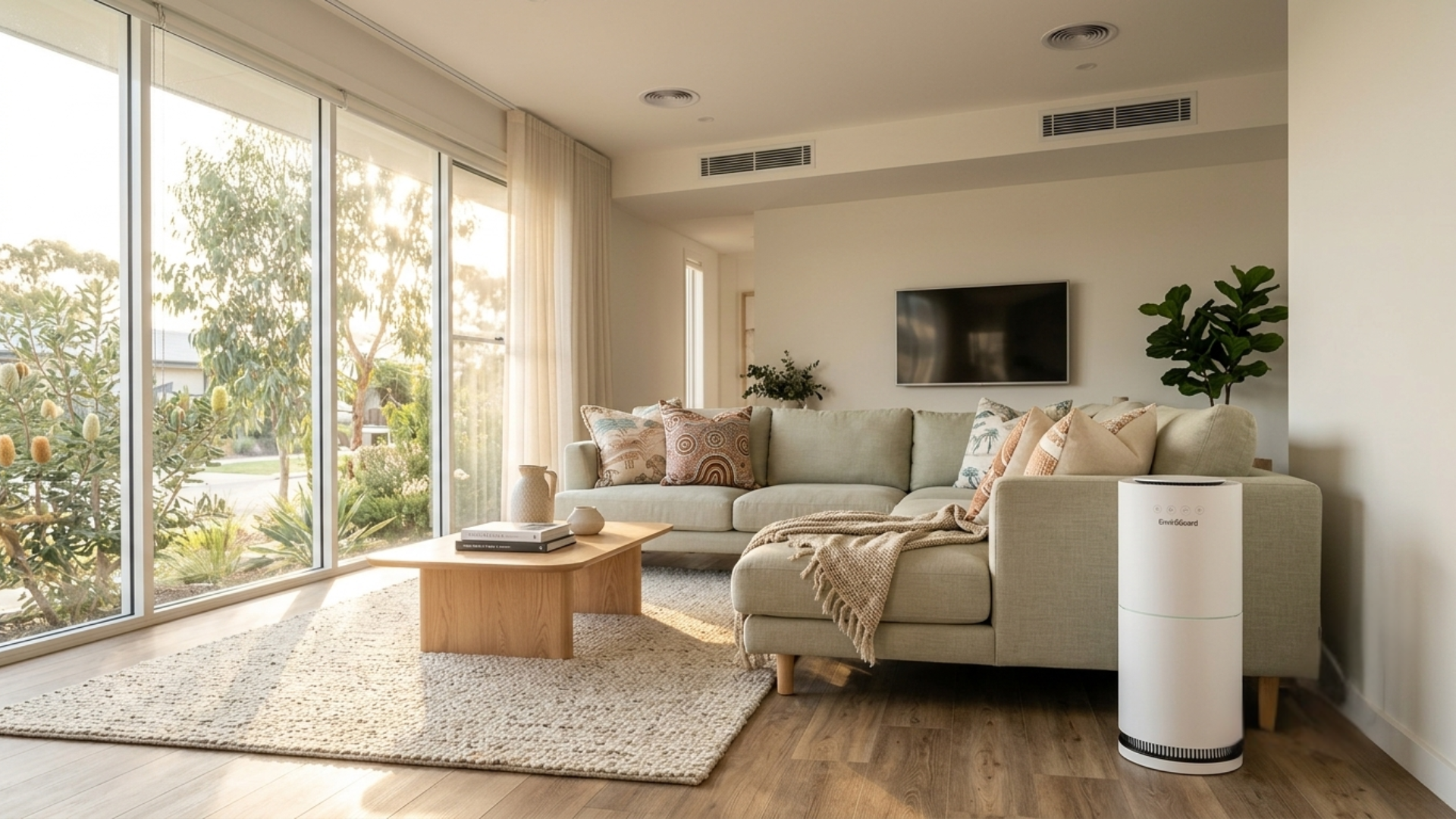
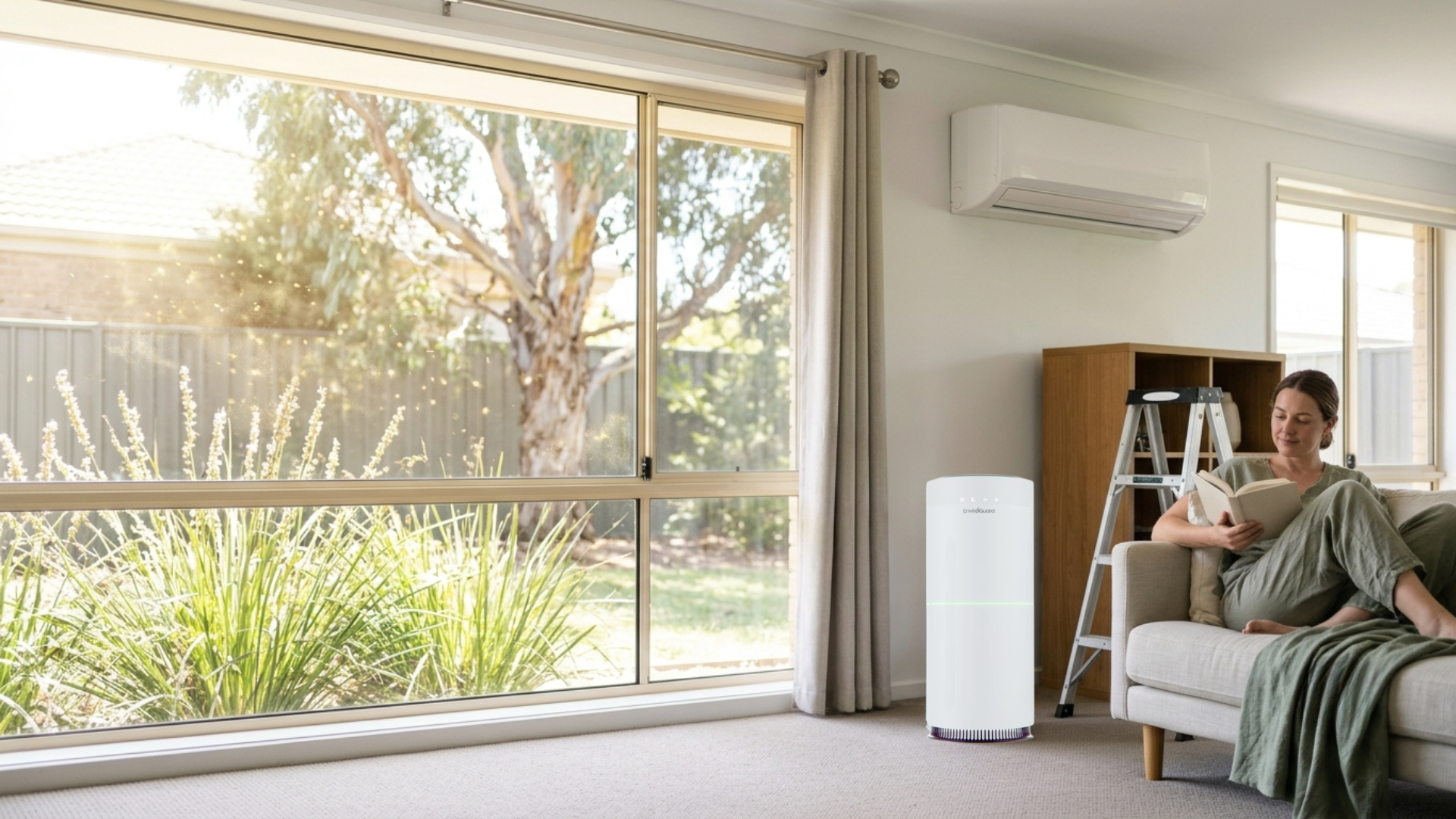
A HEPA air purifier is the single most effective addition for an allergy sufferer, because it removes the particles your AC filter misses. Pollen grains, dust mite allergen and mould spores are all comfortably larger than the 0.3-micron particles a HEPA 13 filter is rated to capture, so a correctly sized unit clears them from a closed room within an hour or two.
Three things decide whether a purifier actually helps:
- Size it to the room. The number to check is CADR, the volume of clean air delivered per hour. The EnviroGuard PRO Xdelivers 540 m³/h, which Aeris rates for 25–100 m²: about eight air changes an hour in a 25 m² bedroom, four in a 50 m² living area and two in a 100 m² open-plan space. For allergies, aim for the higher end of that range in the room where you sleep.
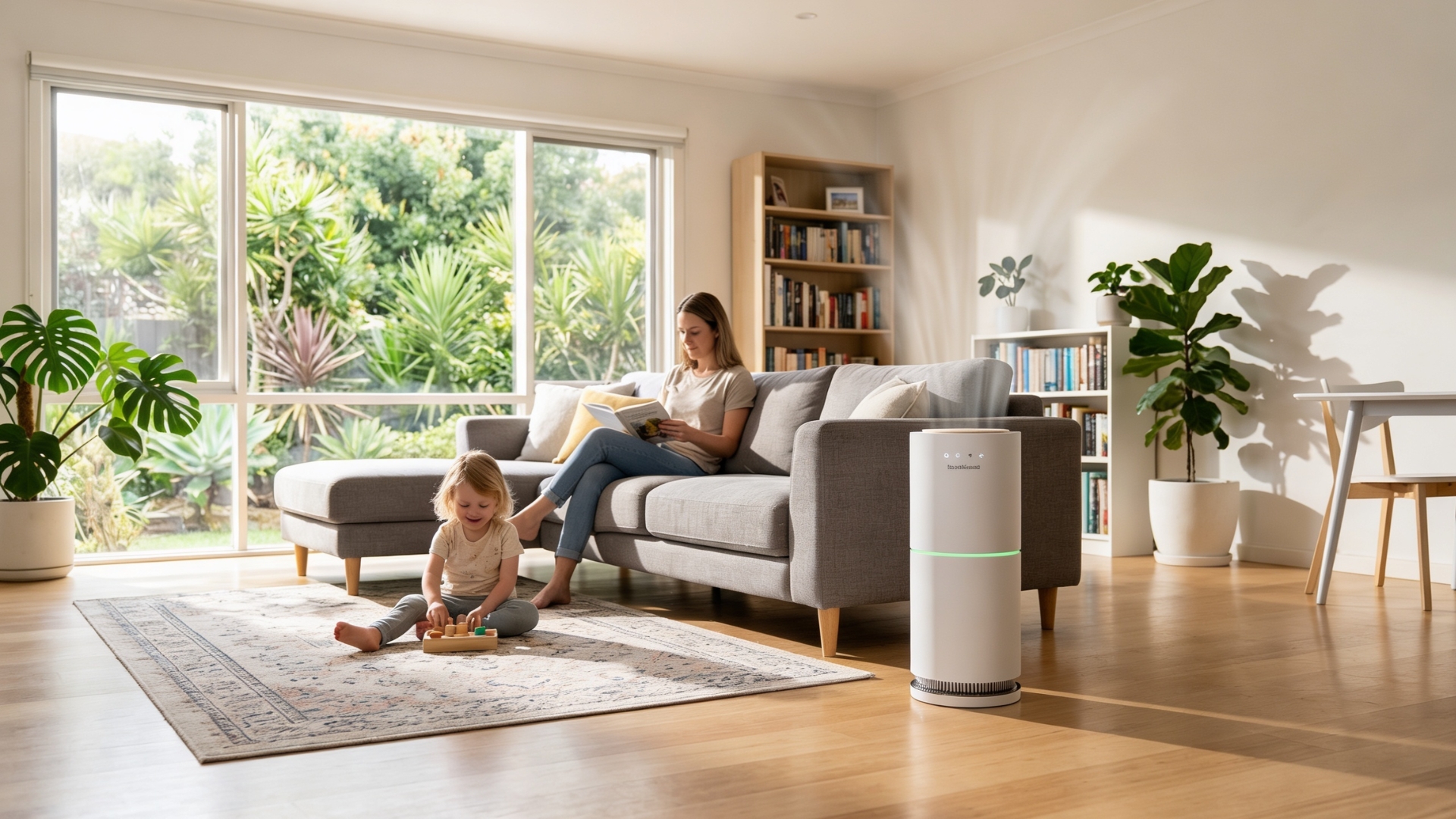
- Put it where you spend the most time.For most people that is the bedroom, with the door closed and the unit running all night. A purifier in the hallway does very little for the person asleep two rooms away.
- Run it continuously through the season.Pollen comes in every time a door opens. A unit switched on only when symptoms flare is always catching up.
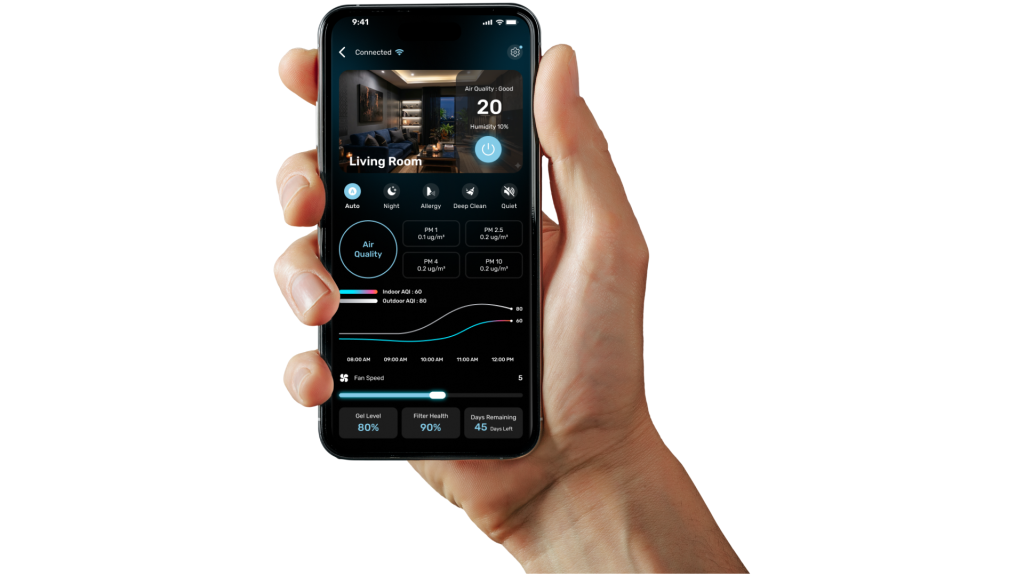
The EnviroGuard PRO X also carries an activated carbon stage and a particle sensor that shows PM1 to PM10 readings in its app. That sensor is more useful than it sounds: watch it jump when you vacuum or open a window on a windy afternoon and you will quickly learn what sets your symptoms off. Its optional Purox Gel cartridge adds surface sanitisation, which matters more for mould than for pollen.
For offices, childcare centres and aged care facilities, a portable unit per room is often impractical. A duct-mounted bi-polar ionisation system such as AtmosAir treats the whole building’s air through the existing HVAC. Our comparison of air purifiers versus HVAC filtrationexplains when each approach fits.
Filter Selection and Treatment
The filter in a typical Australian split system is a plastic mesh. It catches lint, hair and the larger dust that would otherwise clog the coil, and almost nothing else. It is a coil protector, not an allergy filter, which is why a HEPA purifier is still needed in the bedroom.
Ducted and commercial systems take replaceable pleated filters, and here you have a choice. A higher-rated filter captures finer particles, including pollen, but also restricts airflow and makes the fan work harder. Before you upgrade, ask your technician what the unit is designed to handle; a filter that is too dense can cause the coil to ice up or the system to short-cycle.
Whichever filter you have, treat it. Filters work by holding dust, and the dust they hold is food for mould and odour-causing bacteria. By mid-season an untreated filter is a colony. AerisGuard Bioactive Filter Treatmentis sprayed onto a clean or new filter and slowly releases active compounds into the trapped dust, so the growth never takes hold. Aeris lists up to 12 months of protection against mould and bacteria, improved airflow and longer filter life. Read the label and follow the directions for use.
A simple season schedule for a home:
Surface Cleaning Protocols
Clean air doesn’t last if the surfaces keep reloading it. ASCIA’s allergen minimisation adviceis the starting point, and most of it costs nothing.
- Wash bedding weekly above 60°C.This kills dust mites and washes out their allergen. Cooler washes remove the allergen for a while but the mites survive.
- Cover mattresses, pillows and quiltswith dust-mite-resistant covers.
- Damp dust hard surfaces weeklywith a damp or electrostatic cloth. Dry dusting just moves the allergen into the air.
- Vacuum with a HEPA vacuum, ideally while the allergic person is out of the room, and wait 20 minutes before they return. Every vacuum stirs up allergen before it removes it.
- Keep humidity down.Dry washing outside, run exhaust fans and air the house on low-pollen mornings. Dust mites and mould both need moisture.
- Change clothes and rinse hairafter mowing, gardening or a windy afternoon out, and keep pets off the bed through the season.
Mould needs its own treatment. Scrubbing it with detergent spreads spores and leaves the roots in place. Aeris Mould Pro is a triple-action remover that kills the mould, lifts the stain and helps stop regrowth; our guide to removing mould from walls permanentlywalks through the method.
In offices, childcare centres and aged care, where many hands touch the same desks, rails and toys, a residual treatment cuts the cleaning load. AerisGuard Surface Treatment leaves a bioactive layer that keeps mould and bacteria from recolonising between cleans, and Surface Cleaner & Sanitiserhandles the daily wipe-down.
FAQs About Allergies and Indoor Air Quality FAQs About Allergies and Indoor Air Quality
When does allergy season start in Australia?
Grass pollen season in southern Australia runs from 1 October to 31 December, which is when most hay fever peaks. Tree pollen starts earlier, from about mid-July. Brisbane and Darwin have no clear season. Indoor allergens such as dust mites and mould are present all year.
Does air conditioning help or worsen allergies?
Both, depending on its condition. A clean system with a sound filter traps pollen and dust and can make a room noticeably easier to breathe in. A system with a dirty filter and a mouldy coil spreads spores and fine dust through every room. Clean and treat it before October and it is on your side.
Do HEPA filters help with pollen allergies?
Yes. HEPA 13 filters are rated to capture particles down to 0.3 microns, and pollen, dust mite allergen and mould spores are all larger than that. The filter only helps if the purifier is sized to the room and runs continuously, with the door closed.
What size air purifier do I need for allergies?
Match the CADR to the room. Aeris rates the EnviroGuard PRO X at 540 m³/h, which gives about eight air changes an hour in a 25 m² bedroom and four in a 50 m² living room. For allergy relief, more air changes are better, so err towards a higher CADR for the bedroom.
Can my office HVAC make hay fever worse?
It can. Commercial systems draw in outside air through intake filters, and if those filters are overdue, pollen comes straight in. Ask your building manager when the filter bank was last changed and whether the fresh-air intake can be reduced on extreme pollen days. Whole-building treatment options such as bi-polar ionisation also exist for larger sites.
How often should I clean my AC filter during pollen season?
For a split system, every two to four weeks from October to December, more often if you have pets. Let the filter dry completely before refitting it, then spray it with a filter treatment. Ducted systems should get a new pleated filter before the season starts.
In Short
- Grass pollen season runs 1 October to 31 December in southern Australia; dust mites and mould are year-round.
- Pollen comes inside and stays. Your AC either filters it or spreads it, depending on how clean it is.
- Before October: wash and treat filters, have the indoor coil cleaned and treated, drop a tablet in the condensate pan.
- Run a HEPA 13 purifier sized to the bedroom, continuously, with the door closed.
- Hot-wash bedding weekly, damp dust, vacuum with HEPA, keep humidity down, deal with mould properly.
Breathe easier this allergy season. The EnviroGuard PRO X combines HEPA 13 filtration, 540 m³/h CADR and live air quality readings in one unit, with a 45-day money-back guarantee. Pair it with AerisGuard Bioactive Filter Treatment on your AC filters for the full season.