Air conditioners near the Australian coast corrode faster because airborne salt settles on the outdoor coil and casing, stays damp for most of the day, and corrodes the aluminium fins and copper tubes that move heat. Units within about 1 km of surf coasts sit in the C4 or C5 corrosivity zones of AS 4312, where unprotected metal corrodes many times faster than inland. The fix is a routine, not a replacement: rinse the salt off, clean the coil properly, then seal it with a tested anti-corrosion coating such as AerisGuard Corrosion Protection Plus. Done before the damage starts; that routine keeps the coil transferring heat, holds energy use down and extends the life of the unit.
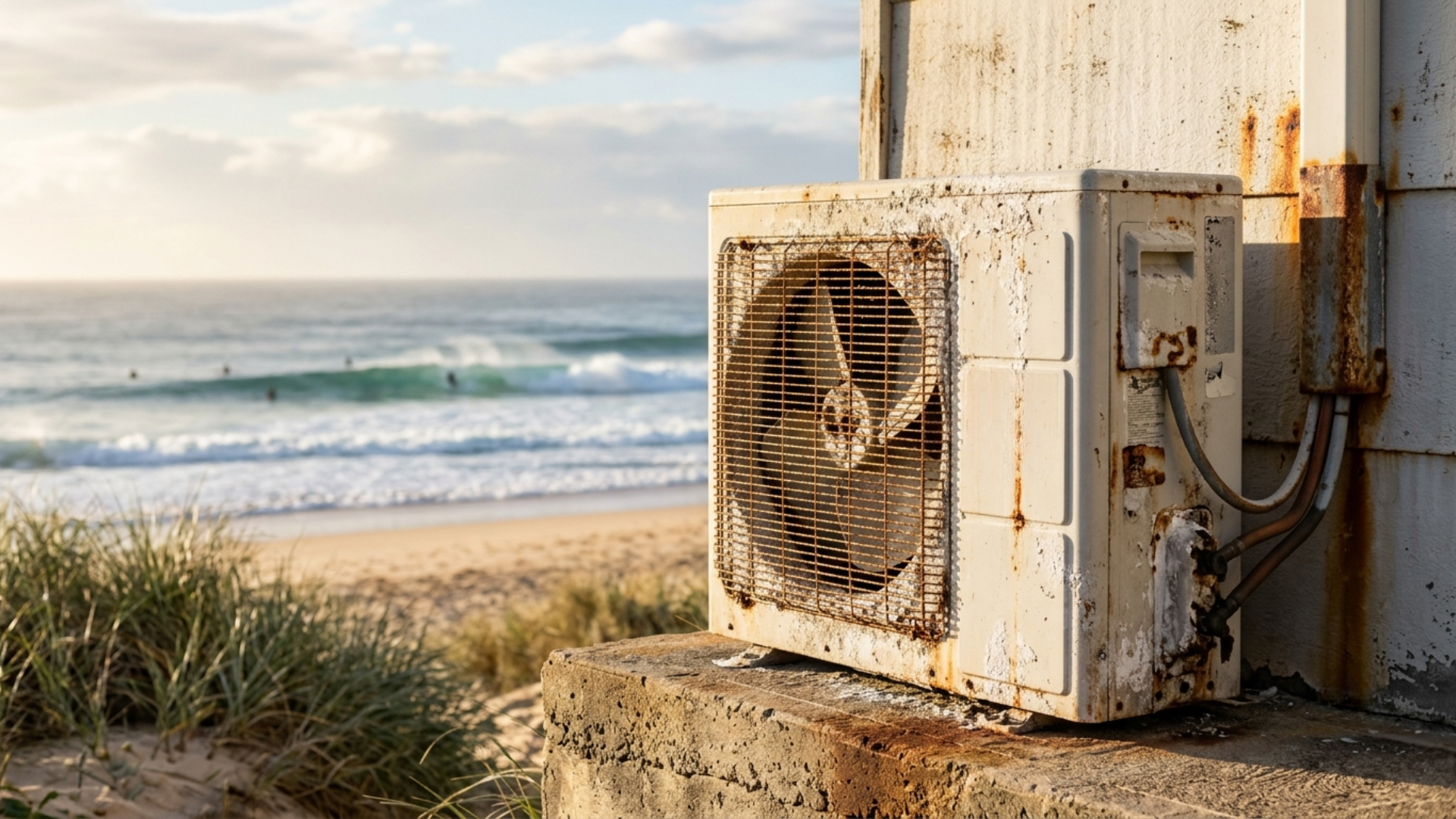
If you have ever pulled the cover off an outdoor unit in a beachside suburb, you know the look. The fins are furred with white powder(corrosion), the coil frame is streaked with rust, and the whole thing is maybe four years old. The same model for two suburbs inland would be clean. Nothing was wrong with the unit. It was simply never built to breathe salt.
This guide explains what salt air actually does to an HVAC system, what premature failure costs, the three problems that cause most coastal failures, and the protection routine we recommend for homes, strata buildings and commercial sites along the coast.
The Science of Salt Air Corrosion
Salt is the problem, and water is the delivery system. Breaking surf throws fine droplets of seawater into the air. The water evaporates, the salt crystals ride the sea breeze inland, and they settle on every outward-facing surface, including the fins of your outdoor coil.
How Salt Accelerates Corrosion
Dry salt on a dry surface does little. The damage starts when the salt gets wet, and on the coast it is wet most of the time. Sea air is humid, overnight dew is heavy, and a running condenser coil is warm on one side and cool on the other, so moisture condenses on it. Salt dissolved in that film of water makes it an electrolyte, and an electrolyte sitting on two different metals turns the coil into a weak battery.
That matters because almost every air conditioning coil is made of two metals: copper tubes pressed through aluminium fins. Aluminium is the more active metal, so it sacrifices itself to protect the copper. The white powder you see on coastal fins is aluminium oxide, the fin material corroding away. As the fins thin and crumble, the coil loses surface area and the system has to run longer to shed the same heat.
Steel parts suffer too. Galvanised casings, fan guards, mounting brackets and screws rust where the zinc coating has been scratched or worn, and the rust stains on the slab under the unit are usually the first thing an owner notices.
Distance from Ocean Impact
Australia classifies its outdoor environments by how fast mild steel corrodes in them. The standard is AS 4312:2019, Atmospheric corrosivity zones in Australia, and the Galvanizers Association of Australia publishes a plain-language summary of its zones.

Two things stand out. First, most of Australia’s capital-city population lives in C3 or worse, so coastal corrosion is not a niche beach-shack problem. Second, the zones are driven by surf and wind, not just distance. A unit 300 m from a surf beach is in a harsher environment than one 300 m from a calm bay, and a site that faces the prevailing onshore wind gets more salt than one that is sheltered behind a building.
Pro tip:If you are not sure which zone you are in, look at the unpainted steel around you. Rusting handrails, fence posts and gate hinges within a year or two of installation are a reliable sign you are in C4 or worse.
True Cost of Premature HVAC Failure

Corrosion costs you three times before the unit finally dies.
Higher running costs. Corroded fins and a salt-crusted coil transfer heat poorly, so the compressor runs longer to reach the same temperature. Aeris’s own testing behind Corrosion Protection Plus puts energy saving from a protected coil at up to 35% compared with an unprotected one in a corrosive environment (product page). Even a fraction of that, across a strata block or a shopping centre, is a real line on the power bill.
More repairs.Pinholes in copper tubes mean refrigerant leaks, which mean a technician visit, a leak test, a regas and often a coil replacement. Rusted fan motors seized bearings and failed contactors follow. Each call-out is money, and each refrigerant’s loss is also an environmental cost.
Early replacement.The coil is the most expensive single part of an outdoor unit. Once it is corroded, the economic answer is usually a new unit. On a coastal site that can mean replacing in half the time an inland owner would expect.
There is also a cost nobody invoices: a unit that limps through February in a beachside aged care home or a coastal restaurant is a comfort and compliance problem long before it is a replacement problem.
Problem: Unprotected Coils and Components
Most outdoor units leave the factory with bare aluminium fins and a galvanised steel cabinet. That is fine in Canberra. On the coast, it is a countdown.
Some manufacturers offer factory-coated coils for marine environments, and they are worth specifying if you are buying new. Many units installed along the coast, though, were chosen on price or availability, not corrosivity zone, and have no protection at all. The fins start pitting in the first summer and the owner has no idea until the unit stops keeping up.
The weak points, in the order they usually fail:
- Fin edgeson the side facing the wind, where salt lands first and the aluminium is thinnest.
- The fin-tube joint, where two different metals sit in the same film of salt water.
- Cut edges and screw holesin the galvanised cabinet, where the zinc layer is broken and bare steel is exposed.
- Fan guards and brackets, often the cheapest steel on the unit.
The answer is to put a barrier between the metal and the salt before the first season, or to clean and coat an existing unit before the pitting goes deep. Our guide to protecting new HVAC coils from corrosioncovers the new-install case in detail.
Problem: Inadequate Maintenance in Harsh Environments

An annual service designed for an inland unit is not enough for a coastal one. Salt builds up continuously, and a coil that is only looked at once a year carries twelve months of deposits by the time anyone touches it.
Three maintenance mistakes we see on coastal sites:
- No rinsing between services.A simple fresh-water rinse of the outdoor coil every month or two, with a garden hose on gentle pressure, washes off most of the salt before it does damage. It is the single cheapest thing a coastal owner can do and almost nobody does it.
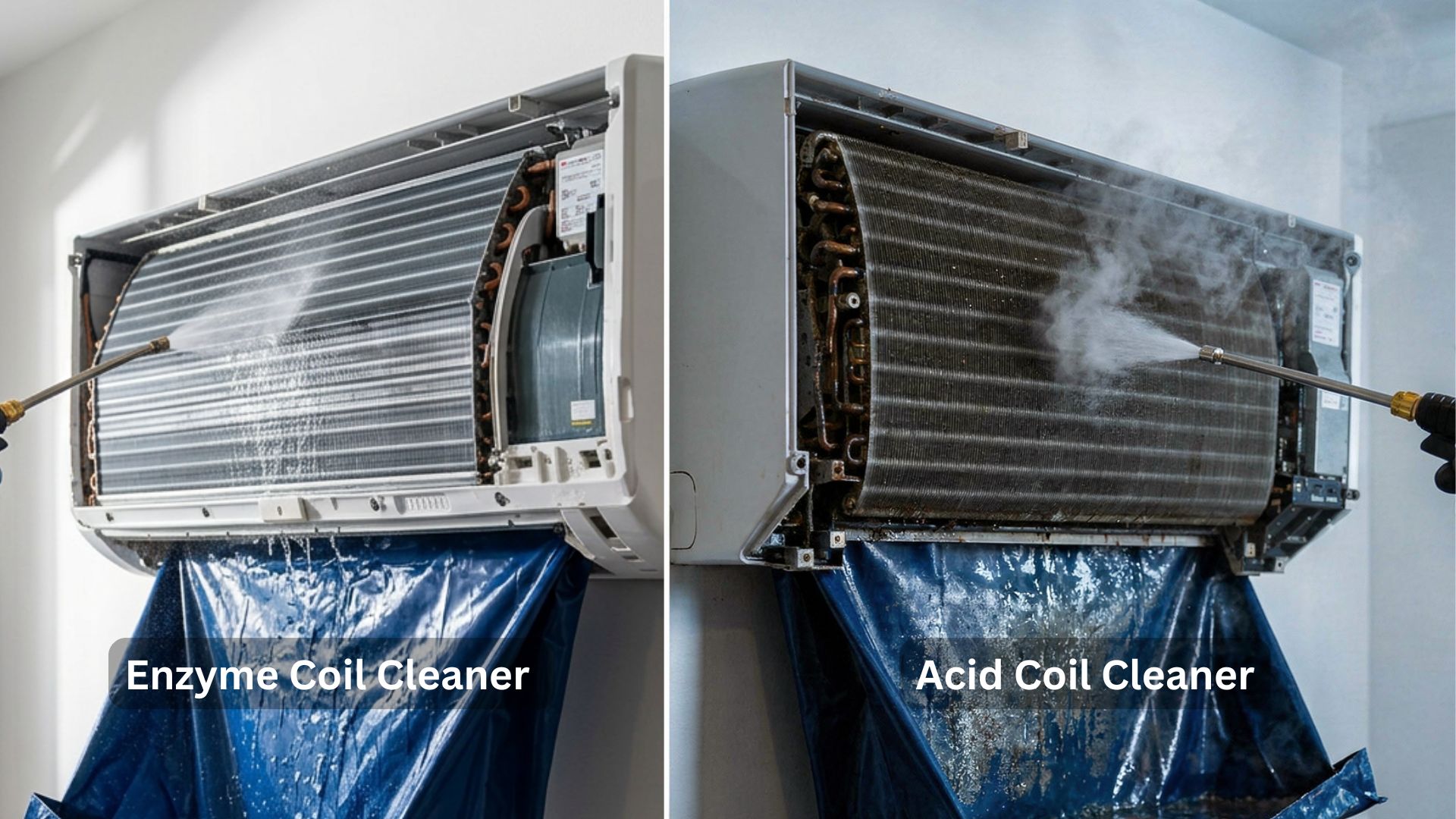
- Cleaning with the wrong product. Acid-based coil cleaners strip grime fast, but they also etch aluminium. On an already-corroding coastal coil, an acid wash accelerates the damage you are trying to stop. A pH-neutral enzyme cleaner such as AerisGuard Outdoor Coil & Surface Cleanerlifts salt, dirt and biofilm without attacking the metal.
- Cleaning without coating.A clean coil on the coast is bare metal with a fresh surface for salt to attack. Cleaning should always be followed by a protective coating, or the benefit lasts weeks rather than years.
For the safe way to do the physical work, including isolating power and protecting the fins, see our guide to maintaining outdoor AC units safely in Australia.
Problem: Wrong Material Choices
Materials that are perfectly adequate inland fail quickly on the coast, and the failures are often in the parts around the unit rather than the unit itself.
- Galvanised brackets and fixings corrode where cut or drilled. In C4 and C5 zones, stainless (316 grade) or marine-rated fixings are the accepted choice, and the WA Government’s corrosion protection guidelineasks designers to specify inherently corrosion-resistant materials for sites in C3 to C5 environments.
- Standard copper-aluminium coilsare the norm because they are efficient and cheap. On the coast, the two-metal pairing is exactly what drives galvanic corrosion. If you are buying new for a surf-front site, ask about factory-coated coils or all-aluminium microchannel coils, and compare the warranty terms for marine environments.
- Placement.A unit mounted on the ocean-facing wall of a beachfront building takes the full salt load. The same unit on the leeward side, under an eave, or screened from direct spray sees a fraction of it. Placement is free protection.
None of this requires exotic engineering. It requires that whoever specifies, installs and maintains the unit knows which corrosivity zone it will live in.
Comprehensive Protection Strategy
The routine below is what we recommend for any unit that requires corrosion protection. It is the same sequence a technician uses on a commercial condenser, scaled down for a split system.
Place the unit sensibly.Away from the ocean-facing wall, undercover where possible, with airflow clearance so it dries quickly after rain and dew.
Coat before the first season. On a new coil, wash and dry the surfaces, then apply AerisGuard Corrosion Protection Plus. It is a self-etching, water-based polymer coating applied by spray, aerosol or bulk, so a service technician can do it on site without a specialist applicator. Aeris reports more than 46,000 hours of ASTM B117 salt spray testing and no effect on airflow or heat exchange. Use the Blue version on coils and the Clear on casings and other surfaces.
Clean an existing coil before coating. Rinse with fresh water, apply Outdoor Coil & Surface Cleaner, rinse again and let it dry completely. Then coat as in step 3. For a home split system, the Outdoor Corrosion Protection Packbundles the cleaner and the Clear coating aerosol for one visit.
Rinse between services.A gentle fresh-water hose-down of the outdoor coil every four to eight weeks through summer removes most of the salt load. Avoid high pressure, which bends fins.
Replace vulnerable hardware.Swap rusting screws, brackets and fan guards for stainless or marine-rated parts at the next service rather than waiting for failure.
Inspect twice a year, not once.Spring and autumn. Look for white powder on fins, rust streaks under the unit, and any refrigerant oil stains that suggest a pinhole leak.
The indoor side matters too. Coastal humidity feeds mould on the evaporator coil, and our summer HVAC preparation guidecovers cleaning and treating the indoor coil and condensate pan.
Pro tip:Run your fingernail gently along a fin edge on the windward side. If it crumbles or leaves white dust on your finger, the coil needs cleaning and coating this season, not next.
Expected Lifespan Improvements
A coated and maintained coil on the coast behaves much more like an inland coil. The fins keep their surface area, heat transfer holds up, the compressor runs for shorter cycles and the unit reaches the age its manufacturer designed for instead of being condemned early.
We deliberately do not quote a single “years added” figure here. The gain depends on the zone, the unit, how it is placed and whether the rinsing and re-coating schedule is actually kept. What we can say is that the coating is tested to more than 46,000 hours of salt spray, that Aeris has measured up to 35% lower energy use on protected coils, and that a coil that never pits does not need to be replaced for pitting.
Coating vs. Replacement Economics
The comparison is simple enough to do on the back of an envelope.

The third row is the one owner forgot. A replacement unit on the same wall, with no coating, starts the same countdown again. Coating is cheap enough that it makes sense on a new unit from day one, and on an existing unit at the first sign of fin corrosion.
FAQs About Coastal HVAC Challenges
How far from the ocean does salt air damage air conditioners?
Under AS 4312, the high-corrosivity C4 zone runs from about 200 m to 1 km inland from surf coasts, and the medium C3 zone extends from 1 km to 10 km, or up to 50 km where onshore winds carry salt further. Most of Australia’s coastal cities sit in C3 or worse, so damage is not limited to beachfront properties.
What does corrosion on an air conditioner look like?
White, chalky powder on the aluminium fins, fins that crumble when touched, rust streaks on the cabinet or the slab beneath it, and oily stains that suggest a refrigerant leak. A unit that takes longer to cool the house than it used to is often corroding before any of these signs are obvious.
Can I protect an air conditioner that is already corroding?
Usually, yes, if the fins are still intact. Clean the coil with a pH-neutral cleaner, rinse, dry and apply Corrosion Protection Plus. If the fins have already crumbled away or the copper tubes are leaking, coating will not restore lost metal, and replacement is the realistic option. Coat the new unit before it goes in.
Does coating the coil reduce airflow or efficiency?
Aeris’s testing of Corrosion Protection Plus reports no effect on airflow or heat exchange performance, and lower energy use on protected coils because the fins stay clean and intact. A thick, badly applied coating of any product can block fins, so follow the directions for use and apply a thin, even coat.
How often should a coastal air conditioner be serviced?
Twice a year in C4 and C5 zones, once in C3, plus a fresh-water rinse of the outdoor coil every four to eight weeks through summer. Clean and re-coat on the schedule your technician recommends for the zone, and replace rusting hardware with stainless parts as you go.
Are some air conditioners better for coastal areas?
Units with factory-coated coils or all-aluminium microchannel coils resist salt better than standard copper-aluminium coils, and some manufacturers offer marine-environment warranties. Whatever you buy, placement and a protective coating at install matter as much as the brand.
In Short
- Salt air plus constant dampness turns a coastal coil into a weak battery that eats its own aluminium fins.
- Within 1 km of surf (AS 4312 zones C4 and C5) unprotected metal corrodes many times faster than inland; most coastal cities are at least C3.
- The cost arrives as higher power bills and repeat repairs long before the unit is replaced early.
- Rinse monthly, clean with a pH-neutral cleaner, never acid, and always coat after cleaning.
- Coat new units before the first season; coat existing ones at the first sign of white fin powder.
Protect your air conditioner from salt air before this summer. AerisGuard Corrosion Protection Plus is tested to more than 46,000 hours of salt spray, can be applied on site by any technician, and has been measured to cut energy use by up to 35% on protected coils. For a home split system, the Outdoor Corrosion Protection Pack gives you the cleaner and the coating in one box.